Why Sustainability Needs More Than Good Intentions
Every year, companies invest millions in sustainability. They support reforestation, biodiversity projects and community initiatives. But one question is becoming increasingly important:
How can we prove that our investment has created real impact?
As expectations for sustainability reporting continue to rise and greenwashing regulations become stricter, good intentions alone are no longer enough. Companies need credible, verifiable evidence.
This is exactly where the TRACA Impact Certificate comes in.
Trust Begins with Transparency
The TRACA Impact Certificate is not a traditional tree-planting certificate, nor is it a carbon credit.
Its purpose is to document what was done, where it happened, and how the project develops over time.
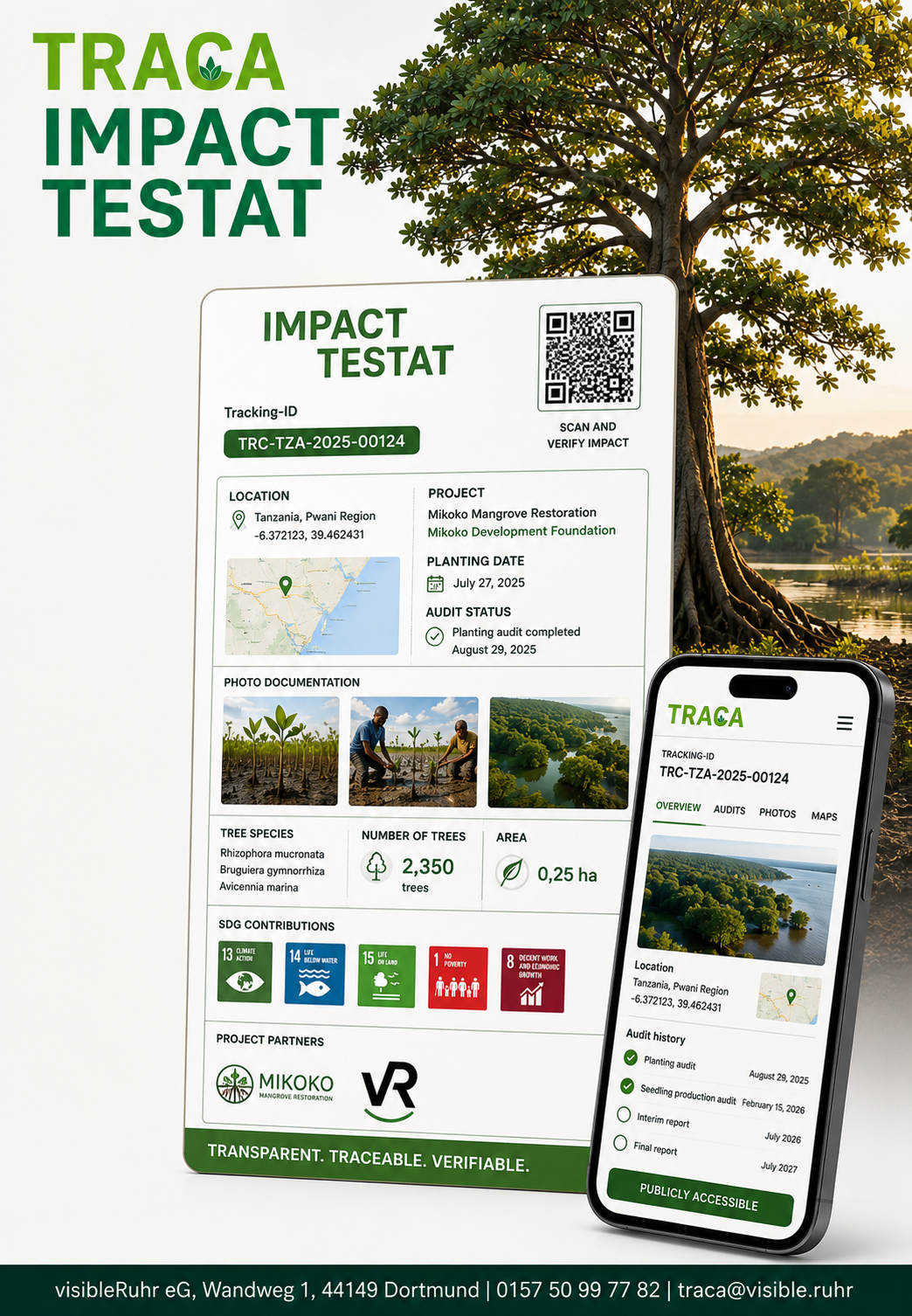
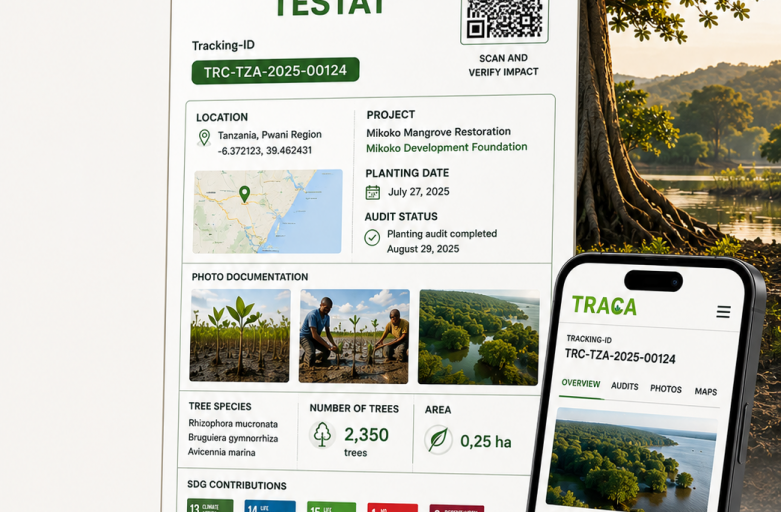
Each restoration project receives a unique digital identity, including:
- GPS coordinates
- Photographic documentation
- Audit reports
- Project partners
- Tree species and planting data
- QR code and Tracking ID
The result is a transparent and verifiable record of real-world environmental action.
We Do Not Sell Carbon Credits
One of the key differences between TRACA and many existing solutions is simple:
TRACA does not sell carbon credits.
Instead, we document verified ecosystem restoration.
Companies invest in restoring nature. The environmental and social impact is documented, monitored and independently auditable over several years.
After the agreed monitoring period, companies do not receive carbon credits in advance.
Instead, they receive a first right of purchase for the carbon credits that this specific restoration area may generate in the future, based on measured and independently verified results.
This ensures that any future carbon credits remain directly linked to the actual performance of the restored ecosystem.
From Seed to Impact
The TRACA Ecosystem follows every stage of a restoration project.
The journey begins long before the first tree is planted.
Local communities:
- collect seeds,
- operate seed banks,
- grow seedlings in nurseries,
- carry out planting,
- maintain the restoration area,
- document progress,
- participate in audits.
The project is accompanied by regular reports:
- Planting Report
- Interim Report
- Final Impact Report
Every restoration area tells its own story—from the first seed to measurable long-term impact.
More Than Tree Planting
One hectare of mangrove restoration typically contains approximately 4,500 to 5,000 mangrove trees.
But the value goes far beyond the trees themselves.
Mangroves help to:
- protect coastlines,
- restore biodiversity,
- create habitats for fish and wildlife,
- reduce coastal erosion,
- strengthen climate resilience.
At the same time, restoration projects create meaningful local employment through:
- seed collection,
- nursery management,
- planting activities,
- monitoring,
- auditing,
- long-term maintenance.
Where project reserves become available, TRACA and its local partners aim to reinvest them into community infrastructure such as schools, healthcare facilities, training programmes and clean water projects.
An ESG Data Package Instead of a Simple Certificate
The TRACA Impact Certificate is designed to become more than a certificate.
It is a structured ESG data package that can support sustainability reporting.
Depending on the project stage, it may include:
- environmental indicators,
- biodiversity metrics,
- social impact data,
- financial transparency,
- project progress,
- SDG contributions,
- audit information,
- future carbon opportunity status.
This allows companies to integrate verified project data into their sustainability communication and reporting.
Why Now?
Sustainability communication is changing.
General environmental claims are increasingly being challenged unless they are supported by robust evidence.
The future belongs to transparency, traceability and measurable impact.
The TRACA Impact Certificate has been designed with exactly this purpose in mind.
Don’t claim it. Prove it.
Our Vision
We do not simply plant trees.
We create trust.
Trust between companies, local communities and restoration projects.
Trust through transparency.
Trust through verification.
Because every restoration project tells a story.
And every verified story creates trust.